Showing posts with label sewing. Show all posts

Tuesday, 1 October 2013

Sewing Tools

If you're ready to add to your costume authenticity by some hand sewing, you may need to add a few items to your sewing box.
  • sewing box, a place to keep all your dandy tools
  • sewing bird, hemming bird
  • hand needles
  • thimbles
  • beeswax
  • pincushion
  • emery 
  • awl
  • grommet setter
  • self-covered button kit
  • thread scissors or snips
You're probably already familiar some of these items. 

You should already have hand needles. I covered some basic stitches in How Authentic Do You Want To Be? 

If you're doing hand stitching, a thimble will be both an asset and an annoyance, depending on how you learn to use it. Thimbles are used not only to push a needle through difficult or many layers of fabric, but to keep you from hurting yourself. Sewing through heavy fabric can really wreak havoc on your fingers. All sorts of materials can be used to make thimbles, but you probably won't want to use a decorative china thimble for a lot of sewing. Metal thimbles are standard and less breakable than plastic ones, although those can be a good substitute. (Not, of course, if you're doing handwork at a reenactment or faire.) Thimbles do come in various sizes, so be sure you get one that fits. You may also want to get a leather thimble. It's more adjustable, plus, due to its flexibility, you can grab the needle more efficiently.


Beeswax is used to keep the thread from tangling and to move through the fabric more smoothly. You can wax the thread either before or after you've threaded your needle. Just run the thread through the beeswax and you're done.


A pincushion will give you a place to keep your needles and pins. Pincushions come in all kinds of styles,although these days we're most used to the ones shaped like tomatoes. Sometimes they come with a strawberry attached. The strawberry usually contains...

...Emery. This is used to keep your needles and pins sharp and free from rust. Nowadays most needles and pins are made of stainless steel, but you'll still need to sharpen them from time to time. A sharp needle pierces the fabric more efficiently. 


An Awl is used to ream holes in eyelets. If you're making corsets or anything that requires lacing, you'll be making eyelets. You may ream the hole before or after you install the grommet (unless you're stitching them by hand using the buttonhole stitch). 


A Grommet or Eyelet Setter will help you safely squeeze the two halves of the grommet or eyelet together with the fabric sandwiched between them. Grommets will make a sturdier hole support for lacing than the buttonhole stitch, but it's up to you which you choose. There are two types: the tiny one that is available with a set of eyelets, used if you aren't setting a lot of eyelets or grommets. If you use lots of grommets, you may want to invest in a grommet setter/hole punch with a rotating wheel. This is not only quicker and easier on your hands, but allows you to set various sizes of grommets with just one setter.


Self-covered button set. These are usually available at the fabric store. You can find them with the setter included, or get a refill set that has just the buttons. I've had mixed results with self-covered buttons. My observation is that they work best with thin fabrics. However, you can use them with velvet if you cut the circle of fabric larger and skip the backing completely. I'll be doing a post on buttons soon with instructions on how to make self-covered buttons. 


The sewing bird or hemming bird is like a third hand. (Indeed, one brand calls it Third Hand!) During the Victorian Era, these little tools were sometimes shaped like actual birds. Nowadays they're simpler, but they do the same thing. You attach the sewing bird to a sturdy table or to the arm of a chair--whatever it will fit. Turn the screw until it holds firmly. Then you fasten the fabric into the clip and it will hold it steady for you while you work the seam or the hem. Another neat usage for the sewing bird is to hold strands of thread or yarn for braiding. I've braided raffia using mine, and it works great. (It does slip on occasion, but that's easily remedied.)


Thread scissors are small, like embroidery scissors, which you can use for that purpose. You can also use a tiny shear to clip threads, especially if you're reenacting. 


We'll talk about scissors, shears and rotary cutters at another time. How you cut out your fabric is a matter of personal preference. Most likely you won't be cutting out fabric pieces during a reenactment. However, if you are, there are antique-style scissors and shears available out there. 

I hope you enjoy your hand sewing! 

Tuesday, 24 September 2013

Fabrics, Part 2

It may come as a disappointment to discover that some historical fabrics are no longer available today. What we call muslin is a vastly different thing from Regency muslin. That was a fine and elegant cotton fabric, suitable for day dresses, and sometimes woven with "sprigs," as was illustrated on the cover of an excellent romance by Georgette Heyer.

Muslin nowadays, at least in the USA, is nowhere near the lovely, delicate fabric that made such dainty dresses. In order to get the same look, you'll need to substitute similar fabrics. Cotton gauze or a fine batiste will give much the same effect. Silk muslin or mousseline is still in use, but has a stiffer weave. You can also use lightweight printed cottons to much the same effect.

The movie versions of Jane Austen's novels had such a problem, which they solved admirably. Note the similarity between the actual printed cotton fabrics in the Museum of Costume in Bath, UK, to the costumes used by the BBC. Polly Maberley wore the yellow printed dress as Kitty Bennett in the 1995 BBC television production of Pride and Prejudice. Note how similar it is to the actual period dresses show just behind it. For more information, be sure to visit the Museum of Costume website. (Link above.)

1871 Parisian Mourning Dress
Surrender Dorothy has this
page from a fashion magazine
offered on their page.
Another fabric you may have difficulty finding is bombazine. (Also spelled bombasine.) This was a heavy silk and woolen blended twill, with a silk warp and worsted woof. Black and dark blue were the most typical colors, and it was used most often for mourning garments, especially in the Victorian Era.

TextureImages.net shows this incredible photo, giving an idea of just how firm a fabric you'll need as a substitute. While jean can be suitably heavy, it won't have the slight sheen the silk gives. You can use a woolen twill, or search for a heavy silk twill.
While searching for bombazine online, I came across Thistle Hill Weavers. They don't offer bombazine currently, but they do work with the fibers that go into it, and they take custom orders. It would be expensive, but if you absolutely must be completely authentic, you could request a custom order.

Whatever you decide in creating your costume, enjoy the process. Finding the right pattern, fabric and trims is half the fun!

Happy Sewing!

Tuesday, 17 September 2013

How Authentic Do You Want to Be?

When you have chosen your time and your character, the next problem you'll face is authenticity. How authentic do you have to be in order to be correct? If you're doing living history, you'll probably need as close to 100% authenticity as possible.

If you want to be authentic and not just look it, you can't use a sewing machine for costumes prior to the 1860s. While there were some sewing machines beginning in the 1850s, they were not generally available. In addition, the original sewing machines were not lock-stitch like modern machines. Using just one thread, the machine sewed a chain stitch. That was fine....unless a thread broke. Then the entire seam ripped out!

In 1877, the Merrow Company began manufacturing crochet machines (known today as overlocks or sergers). They are still made today. While I've been unable so far to locate information on how much the original overlocks were used in the late 19th Century, you can certainly use them for 20th Century costumes, especially beginning with the 1980s.

If you are like most of us, you find the idea of hand sewing an entire garment daunting! For cases like this, you can compromise and use a sewing machine for interior seams that will not be seen. For all external stitching, you can do hand work. Hems, for example, will look more natural if done by hand rather than machine stitching. (You can compromise and use the blind hem stitch, but unless your costume is late 20th century, I'd avoid serged hems and even topstitching.)

If you have never done hand sewing (and with the great machines on the market these days, many people haven't), why not start with small projects until you master the stitches? The sampler was a teaching aid for many of our young ancestresses. While many of them show only decorative stitches, you can make your own sampler with assorted hand stitch work, and then use it as your guide as you construct your garment.

Here's a list of the basic stitches you'll need the most.

  • The Running Stitch
    • Just the way it sounds, this is a simple, straightforward stitch. Like a machine chain stitch, however, if it breaks, the entire seam is apt to unravel. If you're going to do a running stitch, I recommend adding a Backstitch every few stitches.
  • The Backstitch
    • Viewed from the top of the seam, a backstitch looks exactly like machine stitching (if you have a steady hand). The other side of the seam, however, tells a different story. I like to think of this stitch as "one step forward, two steps back," although it is definitely not a bad way to progress. On the back, you see how the needle has moved the length of two stitches. 
    • Backstitch forms a VERY firm join, but it's time consuming. Worked in combination with Running Stitch, it works great.
  • Hem Stitch
    • This stitch can be as firm or flexible as you need, depending on the fabric. You can take just one thread, and make the stitching almost invisible. 
Naturally, you can use decorative stitches, but for costuming purposes, those fall more under the classification of embroidery.

One thing you will notice if you do decide to make the entire costume by hand: even if you press the seams open, they will not be as perfectly smooth as a machine stitched seam. You'll see a slight waviness, due to the nature of hand sewing. This is perfectly all right, and even desirable in some cases. How durable the seam is depends on which stitch you use.

So, to recap: if you don't have the patience to make a costume entirely by hand, go for just the visible parts. Hemming by hand will make a big enough difference to most costumes. Costumes with visible outer stitching may be done by hand.


Tuesday, 13 August 2013

Time to Sew

Perhaps a better title for this would be "No Time to Sew!" In today's society, when it's possible to be busy 24/7, it's sometimes hard to fit in time for things we love to do. Work and family can swallow up even our "extra" time.

Still, it's important to our mental health for us to have a bit of time we can devote to doing something we love. The old saying had it "All work and no play makes Jack a dull boy." (Of course, all play and no work can have even more disastrous results, but that's another story.)

If costuming is your love, you won't be able to bring a huge sewing project with you wherever you go. It's impractical, and people will give you suspicious glances. However, one overlooked aspect of costuming is accessories. Some of these are highly portable, attract favorable rather than displeased attention, and will get your costume farther along. Here are some suggestions:

Lace handkerchiefs.

  • Whether or not you make your own lace, you can bring a small square of linen with you. The rest of your supplies will include either pre-made lace and a needle with matching thread, or, if you're a tatter, a tatting shuttle and reel of cotton. 
  • Handkerchiefs were an important part of life before the invention of facial tissue, and whether or not  you use it according to its original purpose, your outfit will be more complete with a "hankie." Be sure to match the style and size of lace to your costume period and Sumptuary Laws, if they exist in the time frame. Some earlier reenactment periods don't allow for lace.

Lap quilt.

  • You can't bring a huge quilting frame with you everywhere you go, but you can bring a quilting hoop to work on individual squares that you can sew together later. Georgia Bonesteel's excellent books and programs on the concept of Lap Quilting changed the way a lot of people quilt, including me! 
  • It may seem counterintuitive to say you can have more time for quilting if you hand-piece rather than sew by machine, but if you have little time to sit down and sew and lots of time when you're having to wait for something (say, in a doctor's office, at the garage getting your car repaired, etc.), it can be an easy way to get time to quilt into your day! 
  • Even if you machine piece the top first, you can still bring individual squares with you to hand-quilt with a relatively small quilting or even an embroidery frame. 
  • The added benefit of hand-piecing is that you can bring it safely to a reenactment without fear of modern techniques being ridiculed by the purists.
Gloves.
  • Gloves are appropriate in many time periods, and are small enough to work on while on break, in a waiting room, etc. 
  • Gloves can be hand sewn of fabric or fine glove leather (which will be very thin and pliable). 
  • Gloves may also be knitted or crocheted. I've even tatted gloves, though it's more of a challenge and not for beginning tatters. A combination of techniques may be used. I haven't tried hairpin lace yet, but I'm sure it could be beautifully combined with other needlework to make amazing gloves.
Socks and stockings.
  • If you're truly adventurous and a good knitter, you can bring a sock or stocking pattern with you, along with the appropriate needles for knitting in the round.
  • Silk stockings can be cut out of the silk at home and then hand sewn, which could be done anywhere. 
  • You can embroider "clocks" onto silk stockings that haven't had their back seam sewn yet, and have an appropriate and much less expensive addition to your 18th Century costume.


Scarves, shawls and cravats.

  • Scarves and shawls have gone in and out of favor over the centuries, but for those time periods where they are popular, they make a great accessory.
  • A scarf can range anywhere from 14 inches square (roughly 35.5 cm) to the long, narrow versions in favor with early twentieth century pilots.
  • Shawls vary in shape and size from the very small (which can sometimes mimic a Bertha collar) to ones large enough to wrap around you twice. 
  • Cravats should be of fine, crisp linen, which you should cut outwoven or sewn.  beforehand and then can hem using the rolled handkerchief hem technique. 
  • Scarves and shawls can be knitted, crocheted, 
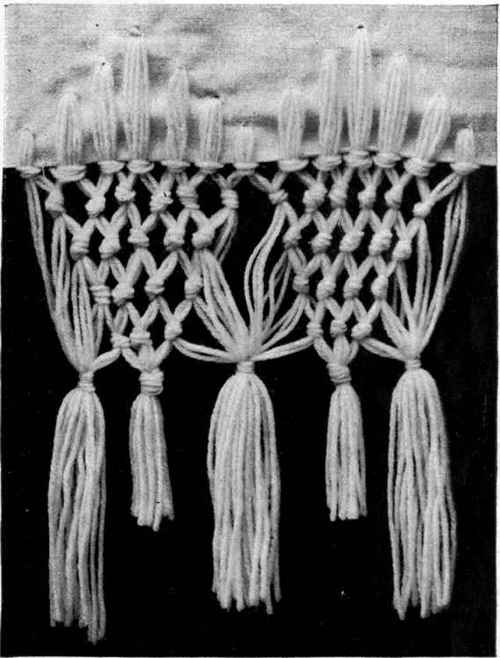
  • A popular pastime in the Georgian and Regency periods in England was "knotting a fringe" for shawls. This was macrame, pure and simple, and could be a small enough project to carry with you. The original fringes were most likely of silk. While the cost would be prohibitive for many of us, rayon threads would make an acceptable substitute. 
I'm sure there are other accessories one could make that have small enough parts to bring along with you. I didn't mention beadwork, because if the beads get away from you in a crowded room, you'll never manage to recover them all! Any kind of jewelry making is also best done at home or in your workshop, if you're blessed enough to have one. 

I hope today's blog will inspire you to find something portable to work on while you're away from home, or while you're at home entertaining company. Who knows, your friends might like to join you in starting a small project of their own! 

Tuesday, 5 February 2013

What's the Bane of Your Costuming Existence?

I don't know about you, but mine is polyester thread! Sure, it stretches, which makes it great for things like swimsuits and exercise garments. The only problem with it is this:

It's stronger than the authentic fabrics we love to use in costuming! That means if you're experiencing problems with a seam being too tight, the thread won't break. The fabric will tear! Naturally, you don't want that to happen.

Unfortunately, finding 100% cotton, linen and silk threads can be difficult. They also cost more than 100% polyester or cotton-wrapped poly threads. However, it's worth paying more if your costume lasts longer, especially if you're planning to get several years of service from it.

If you're looking for 100% cotton thread, some manufacturers include

  • Coats of Coats & Clark fame (who manufacture the aforementioned cotton-coated poly thread, which is great for many applications but not 100% natural fiber sewing)
  • Gütermann, who also have a line of other natural and artificial threads
  • Mettler also produces cotton threads along with their polyester Metrosene thread
Some of these also manufacture 100% silk thread. 
If you're looking for a good source of linen thread, try Lacis. They also carry silk and cotton threads, plus a goodly number of sewing and needlework accessories, many of which will be appropriate for your reenacting activities. 

So, what's your pet costuming peeve? Please feel free to share it here! I'd love to hear from you!

Friday, 1 February 2013

Ways to Get Into Costume

Once you have your costume era and silhouette firmly in mind, there are several different ways to achieve your desired look. Each has its merits, so don't dismiss any of them out of hand until you've explored the options.

  • Pre-made costumes. These are available from costume shops and internet costume sites. Prices vary greatly according to quality, materials used, amount of handwork involved, and country of origin. The more it costs to make, the more it costs to buy.
  • Costumes from a dressmaker or tailor. Here you'll pay the going rate for the sewing provider, and for all materials, including any patterns necessary. 
  • Costumes you make yourself from a purchased pattern. Several pattern companies make costume patterns. In a future blog post, I'll discuss those in more detail.
  • Costumes you make yourself from a book containing patterns to enlarge.
  • Costumes you make yourself from a pattern you develop, either by flat drafting or draping.
If you don't have a single craftsy bone in your body, obviously your best bet will be to buy a costume, either premade or custom made. Premade costumes come in certain sizes, just like regular garments, so you won't have as much choice of how it fits you, unless you have it altered to fit, which can add more money onto the project. 

If you love to sew and make things, however, you should plan on making at least part of your costume. Depending on your skill level, you can come up with something quite wonderful.

And if you're terrible with a sewing needle, take heart. Not every outfit worn by our ancestors was perfectly sewn! Plaids weren't always perfectly matched at the seams. Seams weren't always perfectly straight. Perfection actually can detract from the historicity of an outfit, so feel free to make mistakes.