This time of year, it's almost impossible to think of costuming without thinking of Halloween, that day in which wearing a costume is considered normal. Once upon a time, back in the mid-twentieth century, it was mostly children who wore costumes. If they had mothers who sewed, they might have a very elaborate costume indeed. Or, if they didn't, they might end up wearing a sheet with a couple of holes for eyes, as in "It's The Great Pumpkin, Charlie Brown!"
Nowadays, however, with more and more adults getting into the act, stores devoted to Halloween pop up across the US, temporarily touting costumes and accessories to make them look even more real. Almost any classification of costume is available, from ancient Egyptians through any period of history to horror, outer space, and beyond. If you can find what you want there, fine. Enjoy!
If, however, you want something well-made that will last beyond a wearing or two, you should consider making your own. If you want a complete suit of armor, I do recommend finding an armorer, unless you do auto body work. Some parts and accessories are better left to the professionals. For the rest, however, you can set your imagination to work, find a pattern and just the right fabric, and have some costuming fun!
Many of the major pattern companies have patterns for costuming. Unless you're making costumes professionally, these are a wonderful choice. McCall, Butterick, Kwik Sew, Simplicity, Burda, and even Craftsy all have great costume patterns for sale. You don't have much time left for this year, but you if you go for something easy, you can still come up with something wonderful. Hope these suggestions help!
Showing posts with label easy projects. Show all posts
Showing posts with label easy projects. Show all posts
Tuesday, 22 October 2013

Tuesday, 3 September 2013
Adapting Garments
Happy Tuesday!
Today, I'm discussing an aspect of costume that is great for beginners: adapting clothes you already have to a particular costume period.
Obviously, some clothes are more adaptable than others. You won't be able to take a t-shirt and jeans and turn it into anything earlier than the mid-to-late twentieth century. However, those same jeans, if plain enough, can work for a laborer's mid-to-late nineteenth century costume. Levi's 501 button-front jeans would be the best choice for that, as zippers weren't generally available in men's trousers until the 1930s. That was also the decade in which zippers were first promoted in children's clothing, as a way for children to be independent and easily dress themselves.
First, choose your era. If you're reading this blog, you've probably already done that.
I decided on 1880 for this adapted costume because we were visiting Tombstone frequently and hanging out with friends who reenact the shootout at the OK Corral. (I never got to do any reenacting, but that's beside the point.)
I chose for the upper element a lightweight cotton print dress. It already had several elements going for it
So, choose your period, and then look for clothes you may already have that can adapt to that period. You may be surprised at what you already own that, with a little imagination and a bit of sewing, can become one of your favorite costumes!
Today, I'm discussing an aspect of costume that is great for beginners: adapting clothes you already have to a particular costume period.
Obviously, some clothes are more adaptable than others. You won't be able to take a t-shirt and jeans and turn it into anything earlier than the mid-to-late twentieth century. However, those same jeans, if plain enough, can work for a laborer's mid-to-late nineteenth century costume. Levi's 501 button-front jeans would be the best choice for that, as zippers weren't generally available in men's trousers until the 1930s. That was also the decade in which zippers were first promoted in children's clothing, as a way for children to be independent and easily dress themselves.
First, choose your era. If you're reading this blog, you've probably already done that.
I decided on 1880 for this adapted costume because we were visiting Tombstone frequently and hanging out with friends who reenact the shootout at the OK Corral. (I never got to do any reenacting, but that's beside the point.)
I chose for the upper element a lightweight cotton print dress. It already had several elements going for it
- a squared neckline, which was the standard in the 1880s.
- a lightweight fabric that would be easy to manipulate
- a lapped zipper to which I could sew buttons, making it appear to button up the back (another standard of the 1880s)
- a princess-seamed bodice

Not only that, but it more or less matched the long pleated skirt a friend had given me.
The actual work involved was simple. I sewed plain white buttons onto the zipper lap. Then I gathered the skirt up each side to create a polonaise, sewing by hand and securing the stitches so they wouldn't come loose. This I wore over a long-sleeved blouse with a high neckline and stand up collar, plus the long skirt. Instant 1880s costume. Would it satisfy a dedicated living history reenactor? Probably not. However, it has the look and the feel, and for this costume, at least, that's enough.
I made the hat from some craft felt, lace, and some shoulder pads, then added a purchased bird ornament. If I get enough requests, I may do a post on how to make hats from shoulder pads!
So, choose your period, and then look for clothes you may already have that can adapt to that period. You may be surprised at what you already own that, with a little imagination and a bit of sewing, can become one of your favorite costumes!
Tuesday, 13 August 2013
Time to Sew
Perhaps a better title for this would be "No Time to Sew!" In today's society, when it's possible to be busy 24/7, it's sometimes hard to fit in time for things we love to do. Work and family can swallow up even our "extra" time.
Still, it's important to our mental health for us to have a bit of time we can devote to doing something we love. The old saying had it "All work and no play makes Jack a dull boy." (Of course, all play and no work can have even more disastrous results, but that's another story.)
If costuming is your love, you won't be able to bring a huge sewing project with you wherever you go. It's impractical, and people will give you suspicious glances. However, one overlooked aspect of costuming is accessories. Some of these are highly portable, attract favorable rather than displeased attention, and will get your costume farther along. Here are some suggestions:
Lace handkerchiefs.
Lap quilt.

Still, it's important to our mental health for us to have a bit of time we can devote to doing something we love. The old saying had it "All work and no play makes Jack a dull boy." (Of course, all play and no work can have even more disastrous results, but that's another story.)
If costuming is your love, you won't be able to bring a huge sewing project with you wherever you go. It's impractical, and people will give you suspicious glances. However, one overlooked aspect of costuming is accessories. Some of these are highly portable, attract favorable rather than displeased attention, and will get your costume farther along. Here are some suggestions:
Lace handkerchiefs.
- Whether or not you make your own lace, you can bring a small square of linen with you. The rest of your supplies will include either pre-made lace and a needle with matching thread, or, if you're a tatter, a tatting shuttle and reel of cotton.
- Handkerchiefs were an important part of life before the invention of facial tissue, and whether or not you use it according to its original purpose, your outfit will be more complete with a "hankie." Be sure to match the style and size of lace to your costume period and Sumptuary Laws, if they exist in the time frame. Some earlier reenactment periods don't allow for lace.

Lap quilt.
- You can't bring a huge quilting frame with you everywhere you go, but you can bring a quilting hoop to work on individual squares that you can sew together later. Georgia Bonesteel's excellent books and programs on the concept of Lap Quilting changed the way a lot of people quilt, including me!
- It may seem counterintuitive to say you can have more time for quilting if you hand-piece rather than sew by machine, but if you have little time to sit down and sew and lots of time when you're having to wait for something (say, in a doctor's office, at the garage getting your car repaired, etc.), it can be an easy way to get time to quilt into your day!
- Even if you machine piece the top first, you can still bring individual squares with you to hand-quilt with a relatively small quilting or even an embroidery frame.
- The added benefit of hand-piecing is that you can bring it safely to a reenactment without fear of modern techniques being ridiculed by the purists.

Gloves.
- Gloves are appropriate in many time periods, and are small enough to work on while on break, in a waiting room, etc.
- Gloves can be hand sewn of fabric or fine glove leather (which will be very thin and pliable).
- Gloves may also be knitted or crocheted. I've even tatted gloves, though it's more of a challenge and not for beginning tatters. A combination of techniques may be used. I haven't tried hairpin lace yet, but I'm sure it could be beautifully combined with other needlework to make amazing gloves.


Socks and stockings.
- If you're truly adventurous and a good knitter, you can bring a sock or stocking pattern with you, along with the appropriate needles for knitting in the round.
- Silk stockings can be cut out of the silk at home and then hand sewn, which could be done anywhere.
- You can embroider "clocks" onto silk stockings that haven't had their back seam sewn yet, and have an appropriate and much less expensive addition to your 18th Century costume.


Scarves, shawls and cravats.
- Scarves and shawls have gone in and out of favor over the centuries, but for those time periods where they are popular, they make a great accessory.
- A scarf can range anywhere from 14 inches square (roughly 35.5 cm) to the long, narrow versions in favor with early twentieth century pilots.
- Shawls vary in shape and size from the very small (which can sometimes mimic a Bertha collar) to ones large enough to wrap around you twice.
- Cravats should be of fine, crisp linen, which you should cut outwoven or sewn. beforehand and then can hem using the rolled handkerchief hem technique.
- Scarves and shawls can be knitted, crocheted,
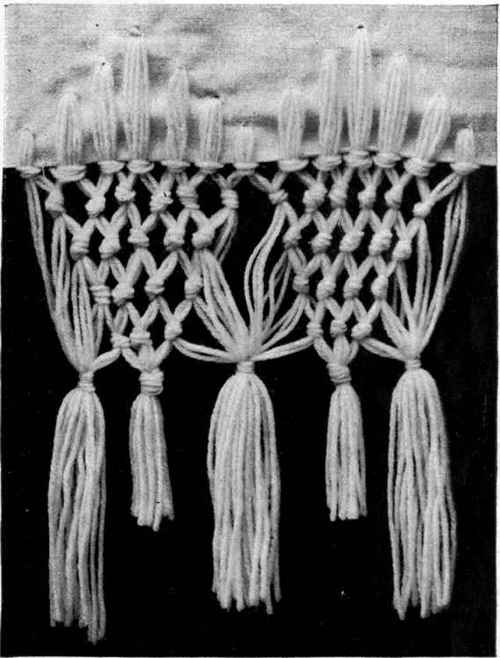
- A popular pastime in the Georgian and Regency periods in England was "knotting a fringe" for shawls. This was macrame, pure and simple, and could be a small enough project to carry with you. The original fringes were most likely of silk. While the cost would be prohibitive for many of us, rayon threads would make an acceptable substitute.


I'm sure there are other accessories one could make that have small enough parts to bring along with you. I didn't mention beadwork, because if the beads get away from you in a crowded room, you'll never manage to recover them all! Any kind of jewelry making is also best done at home or in your workshop, if you're blessed enough to have one.
I hope today's blog will inspire you to find something portable to work on while you're away from home, or while you're at home entertaining company. Who knows, your friends might like to join you in starting a small project of their own!
Subscribe to:
Posts (Atom)